Higher education and the changing world of work: OeAD higher education conference discussed trends in a globally connected future

The OeAD, Austria's Agency for Education and Internationalisation, brought together experts from higher education institutions, science, research and education policy at an internationally oriented symposium. The annual OeAD higher education conference sees itself as a platform for exchange, analysis and design and is dedicated to issues that have a lasting impact on the international higher education landscape.
The OeAD higher education conference 2025 took place on 26 and 27 November at the University of Applied Sciences Kufstein / Tyrol. Under the main theme ‘Higher Education and the World of Work | Global Perspectives’ the focus was on the diverse interactions between academic education and the international world of work. Moreover, the conference focused on two topics that are currently the subject of a particularly dynamic debate: responsible internationalisation and the Global Gateway Initiative as well as the European Commission’s future international priorities for the design of the Erasmus+ programme as of 2028.
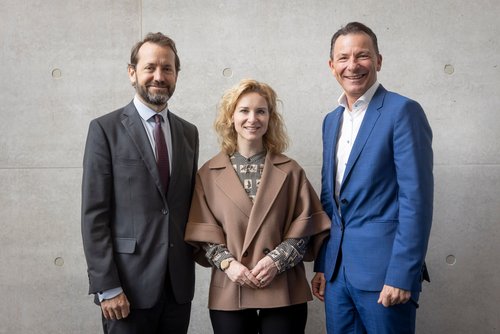
The minister of science and research, Eva-Maria Holzleitner, said: ‘A strong, equitable higher education landscape is the basis that enables everyone to develop their own strengths – regardless of their origin, gender or social background. In a globally connected world we in Austria and Europe must ensure that science remains free and opportunities are distributed fairly. International cooperation must not be a privilege for a few but a reality at our higher education institutions. European programmes such as Horizon Europe, Erasmus+, the European Competitiveness Fund, the European Universities and the European Research Area (ERA) support precisely this approach.’
The OeAD’s managing director, Jakob Calice, said: ‘Higher education institutions are not only drivers of innovation; they are also places where international perspectives are anchored at an early stage and global challenges are reflected upon. In this sense international mobility and cooperation are no longer optional extras but a necessity.’
Higher education and the world of work: skills for a global professional world
How can students be equipped with the skills for the jobs of tomorrow? What job-specific and social skills are employers looking for and how can international study programmes and mobility abroad specifically promote their development? The focus topic explored key questions at the interface between science, business and society. Among other things, the discussion focused on how internationally oriented cooperation models between higher education institutions and companies can support the successful integration of graduates into global labour markets. Moreover, the role of higher education institutions as drivers of innovation was emphasised: as bridge builders between science, business and the world of work and as places where international perspectives are anchored at an early stage and global challenges are reflected upon.
Responsible internationalisation: cooperation in challenging times
The additional topic of ‘responsible internationalisation’ addressed the question of how international cooperation can be made active, resilient and at the same time secure, especially in times of geopolitical tensions and increasing risks of misuse of research results. The focus was on the responsibility of scientific institutions to continue to act as openly as possible but at the same time with the necessary caution in international cooperation.
Europe’s global role: international partnerships and the ‘Global Gateway’
Another focus was the European Commission’s Global Gateway Initiative, which will play a key role in shaping Europe’s international positioning in education, research and scientific cooperation. The conference provided the chance to jointly analyse the opportunities and challenges of this framework and to explore its possible implications for higher education institutions, including future EU programme calls in a global context.
Global Gateway: https://international-partnerships.ec.europa.eu/policies/global-gateway/global-gateway-overview_en
Exchange, classification and impetus
The OeAD conference reflected on complex issues from different perspectives and provided a space for critical discussions, practical examples and strategic outlooks. The aim was to provide impetus for sustainable, globally connected higher education and to further strengthen the dialogue between science and practice.
Thomas Madritsch, managing director of the University of Applied Sciences Kufstein Tirol, said: ‘We are very proud to host the OeAD’s higher education conference at the University of Applied Sciences Kufstein Tirol. As hosts we want to provide impetus for how higher education institutions can actively shape international developments. The exchange here on campus shows how strongly shared perspectives shape our future.’
Accompanying magazine ‘Global Connections’
The OeAD magazine ‘Global Connections’ was published to accompany the conference, offering in-depth articles, interviews and analyses on the main topics of the higher education conference: www.oead.at/globalconnections
APA photo gallery: https://www.apa-fotoservice.at/galerie/39522