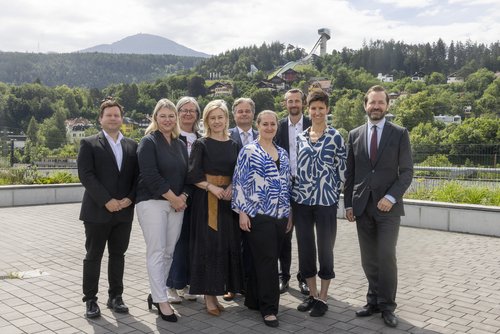
Bologna Day 2026: Presentation of the interim report on the ‘National Higher Education Mobility and Internationalisation Strategy’ (HMIS2030)

At Bologna Day 2026, Austria’s largest annual conference on the implementation of the European Higher Education Area, the focus was on the 2025 interim report on the National Higher Education Mobility and Internationalisation Strategy 2020–2030 (HMIS2030). The interim report documents the progress that Austrian higher education institutions have already made through targeted measures, whilst also highlighting remaining challenges. It is based on the five objectives of HMIS2030: promoting a comprehensive culture of internationalisation; encouraging mobility for all members of the higher education community; developing and implementing innovative mobility formats; effective skills development and institutional learning; and a global mindset (Austrian higher education institutions in the world).
In the run-up to the report’s publication, Minister for Science and Research Eva-Maria Holzleitner emphasised the commitment shown by the higher education institutions: “The interim report on HMIS2030 demonstrates once again that Austria’s higher education institutions are actively driving forward internationalisation. This is not just about periods spent abroad, but also about making international experiences and perspectives accessible to as many students and staff as possible. We want to continue along this successful path whilst responding to new global challenges.”
The interim report, presented by Andreas Pfaffel (WPZ Research), shows that flexible study structures designed to support various forms of mobility are becoming increasingly established at universities. At the same time, there remains scope for further development in embedding international content and intercultural skills within teaching. This would be particularly important for students who are unable or unwilling to go abroad. There are also currently a number of hurdles regarding the recognition of academic achievements and prior qualifications obtained abroad, which hinder student mobility; university staff, on the other hand, are primarily prevented from engaging in mobility due to a lack of time. Furthermore, the report emphasises the importance of a genuine culture of welcome and the successful integration of international students, lecturers and university staff. Particular attention is paid to international students who complete their entire degree programme in Austria and who, against the backdrop of a shortage of skilled workers, could potentially be recruited for the domestic labour market. These topics were explored in greater depth during discussion forums at the Bologna Day.
The closing keynote address by Anja Cziommer and Kerstin Vogelsang (Braunschweig University of Technology) used practical examples to demonstrate how international students can be successfully guided and supported.
OeAD Managing Director Jakob Calice emphasised the OeAD’s role in implementing HMIS2030: “National scholarships and project funding, as well as the opportunities offered by the European Erasmus+ programme, provide higher education institutions with financial support for their internationalisation efforts. Through events such as Bologna Day, networking opportunities and specialist workshops, members of the higher education community also receive information and further training to enable them to successfully and purposefully drive forward internationalisation in their day-to-day work.”
The 2025 interim report on HMIS2030 is available to download from the BMFWF website.
The online platform www.hmis2030.at offers numerous examples of good practice for implementing HMIS2030.
The documentation for Bologna Day 2026 will be published shortly on the OeAD website at www.oead.at.
Photos from the event: www.apa-fotoservice.at