

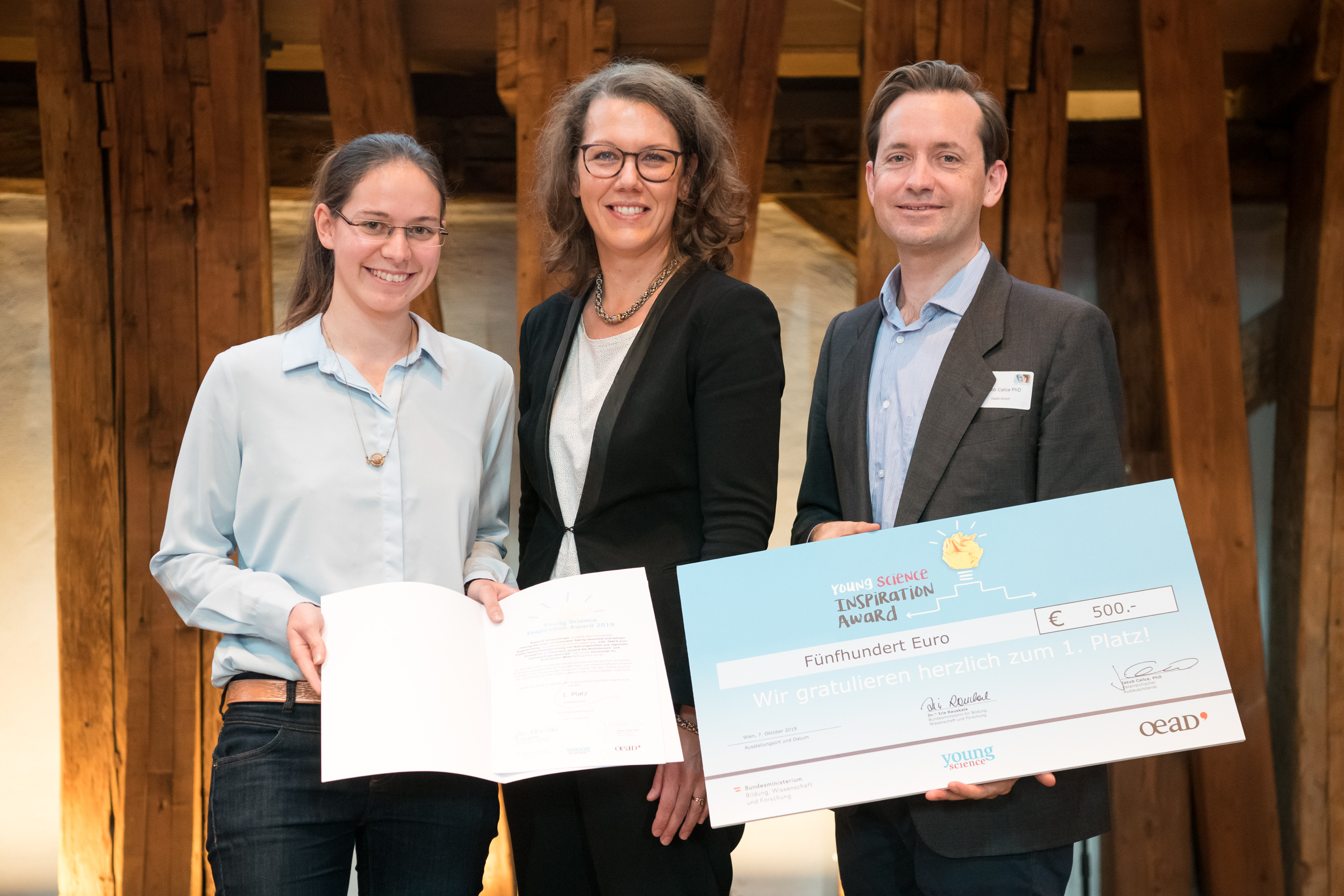
Sparkling Science Congress 2019: Federal Minister Iris Rauskala and OeAD Managing Director Jakob Calice present the Young Science Inspiration Award
Since 2007 the research programme Sparkling Science, funded by the Austrian Federal Ministry of Education, Science and Research (BMBWF), has been combining high-quality research with the promotion of young talent at pre-university level: since 2007 around 100,000 pupils of all ages and school types have answered questions from various research disciplines in almost 300 projects together with more than 4,200 researchers and teachers. With a total volume of almost € 35 million this form of research funding has been and remains unique in Europe. The OeAD implements the programme on behalf of the BMBWF.
‘With the research funding programme Sparkling Science Austria has succeeded in establishing a successful model for cooperation and networking between science and schools, involving civil society in the promotion of young scientists,’ says the federal minister Iris Rauskala with conviction.
Evaluation results presented
The Sparkling Science Congress 2019, held on 7 October at the Vienna University of Technology, focused on the institutional impact of the programme. Sparkling Science has brought about some major systemic changes in some of the participating institutions, i.e. research institutions and schools. These effects were evaluated in a study conducted by Technopolis on behalf of the BMBWF and presented at the event. ‘With the successful implementation of Sparkling Science Austria has succeeded in taking on an important pioneering role in science education at Austrian schools, also by international comparison. The programme has contributed significantly to strengthening cooperation between research and education – also through the broad mobilisation of the key target groups,’ says the OeAD’s managing director Jakob Calice, recapitulating the study results. The study showed that the projects have led to the creation of numerous new networks and partnerships between research institutions and educational institutions as well as with companies. The programme has also had an impact on research, teaching and learning and the acceptance of citizen science. However, the study also points out that such cooperation can only take place on a significant scale if funding is available. To the study
Young Science Inspiration Award: Young people inspire science
The highlight of the conference was the presentation of the Young Science Inspiration Award by the federal minister Iris Rauskala and the OeAD’s managing director Jakob Calice. All young people who had written their pre-scientific thesis (at an academic secondary school) or diploma thesis (at a college for higher vocational education) on a topic suggested on the Young Science thematic platform were eligible to take part. The theses were read by researchers and those with the most inspiring ideas were then nominated for the Young Science Inspiration Award.
From a total of 13 nominations for 2019 the jury selected three papers: ‘Tracing the origin of freshwater fish by elemental and isotopic fingerprinting’ by Susanne Schwendinger (diploma thesis at the technical college Dornbirn), ‘Aquaponics in Austria’ by Johannes Angerer (pre-scientific paper at the Franziskanergymnasium Hall in Tyrol) and ‘Sturmer's Journey. An early modern travelogue from the sixteenth century as a graphic novel’ by Konstantin Holzmeister, Anna-Maria Kovacs and Franziska Ulrich (joint diploma thesis at the technical college Bau und Design Innsbruck). All these papers were briefly presented by the young people on stage during the congress. After a public vote Susanne Schwendinger received the award, which is endowed with 500 euros.
Honouring the most committed education and research institutions
The institutions that were most actively involved in the approximately 300 Sparkling Science projects were also honoured: as regards higher education institutions the University of Vienna, the University of Innsbruck and the University of Natural Resources and Life Sciences, Vienna. Regarding non-university research institutions the Austrian Academy of Sciences, the Central Institute for Meteorology and Geodynamics and the Institute for Jewish History in Austria were honoured for their commitment. As regards schools, the primary school Unzmarkt (Styria), the primary school Grünau im Almtal (Upper Austria), the NMS Zirl (Tyrol), the AHS Rahlgasse (Vienna) and the technical college Donaustadt (Vienna) were most frequently involved in projects.
The conference programme also included a Sparkling Dialogue, a science rally for pupils and the selection of the winning image in the Sparkling Science Challenge.
To the APA photo gallery