

Presentation of the Citizen Science Awards 2019
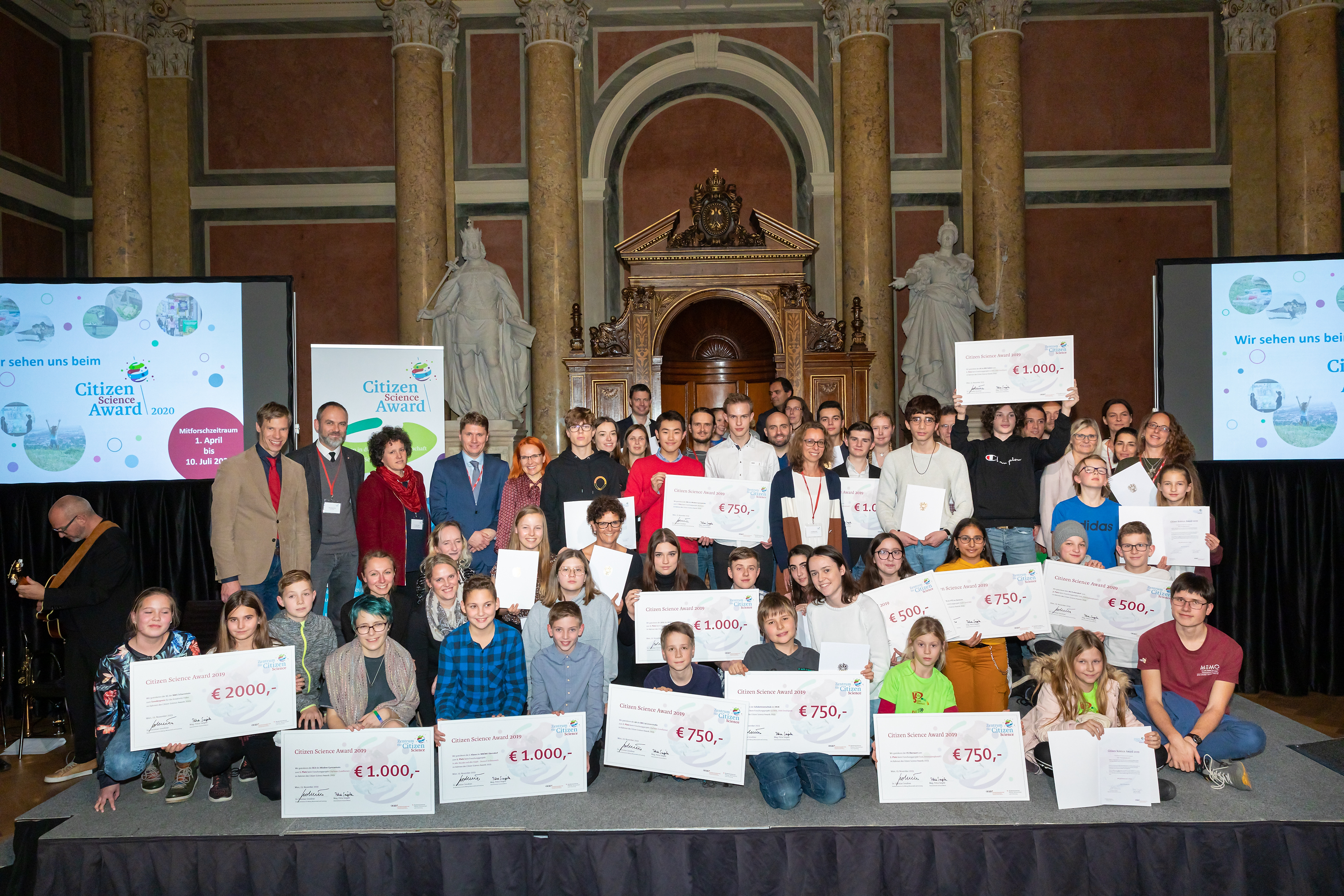
On 19 November the most committed citizen scientists were honoured by the Austrian Federal Ministry of Education, Science and Research (BMBWF) and the Austrian Exchange Service (OeAD) in the University of Vienna’s celebration hall together with the project managers. For the fifth time selected projects were open to public participation in 2019 as part of the Citizen Science Award. 2,100 people responded to the call this year, with the majority of these dedicated citizen scientists engaging particularly intensively with the respective research topic in one of the numerous workshops on offer. More than 48,000 contributions were submitted to the researchers in just over three months.
The Federal Minister Iris Rauskala sent her congratulations to the committed citizen scientists. ‘The great success of the Citizen Science Award is due to its ability to inspire citizens of all ages to take an interest in research and science. The lively interest in the Citizen Science Award shows once more that we are on the right track with our promotion of citizen science in Austria. Thank you all for your great commitment,‘ said Rauskala, thanking the award winners for their contribution to gaining knowledge. ’Science really reaches people when they are not only presented with the results but can also participate themselves. Citizen science is therefore the best way to impart science,‘ concludes Petra Siegele, Head of the Public Science Department at the OeAD.
As a special highlight of the ceremony Karina Grömer from the Natural History Museum gave a keynote speech on the topic of ’Hallstatt-era It girl with sound effects – using citizen science to research cultural heritage to achieve appreciative coexistence". She also organised an accompanying fashion show with clothes from different periods of history, which the pupils of the primary school Oberwart and the BG/BRG Tulln enthusiastically presented.
The winners
A total of 15 schools or school classes and seven individuals were awarded prizes at the ceremony. The following schools received prizes: NMS Kals am Großglockner (Tyrol), PVS Im Zentrum (Vienna), Lauder Chabad Campus (Vienna), BRG Hallein (Salzburg), SchülerInnenschule im WUK (Vienna), BORG Radstadt (Salzburg), primary school Oberwart (Burgenland), BG Purkersdorf (Lower Austria), HLW Freistadt (Upper Austria), Wiedner Gymnasium (Vienna), BRG 14 (Vienna), NMS Oberndorf/Melk (Lower Austria) and BG/BRG Tulln (Lower Austria). The NMS Scharnstein (Upper Austria) received a special prize for the most creative research video. Schools received prize money of up to € 1,000 towards their class funds; the special prize was € 2,000. Individuals received non-cash prizes provided by the projects themselves. ‘For five years now the Citizen Science Award has been inspiring people throughout Austria to take an interest in science and research. Participating in research makes science tangible and understandable for them. Project leaders, on the other hand, gain completely new perspectives on their research by working with citizen scientists. And this is the good thing about
The seven citizen science projects on environment, nature, photography, language and food culture
Stadt-Land-Bild (Academy of Fine Arts and University of Vienna): School classes researched photographs from rural areas.
DreckSpotz (Global2000): The project aims to develop long-term solutions to the problem of litter in nature.
food_history@exploreAT! (International Centre for Archival Research and Austrian Academy of Sciences): Pupils researched, photographed and documented everyday stories about food culture.
NestCams (Konrad Lorenz Research Centre for Behavioural and Cognitive Biology at the University of Vienna): School classes analysed the breeding behaviour of grey geese and northern bald ibises.
CityOases (Federal Environment Agency): Open spaces and green spaces in Vienna were evaluated.
On everyone's lips and in everyone's minds – German in Austria (Centre for Translation Studies, University of Vienna): The topic was research of the linguistic landscape in Austria.
Acrobats of the air wanted (University of Veterinary Medicine Vienna/Austrian Bird Observatory): This project researched the occurrence of barn swallows and house martins in the district of Tulln.
Strengthening science sustainably with citizen science
Citizen science is a working method where scientific projects are carried out with interested citizens. Without their support scientists would often not be able to obtain the information so easily. Moreover, citizen scientists often enrich research by contributing completely new perspectives.
The Citizen Science Award has been funded by the Austrian Federal Ministry of Education, Science and Research since 2015 and coordinated by the Centre for Citizen Science at the OeAD-GmbH. Since the start of the initiative more than 14,000 people have participated in 35 citizen science projects. The centre also acts as a service and information centre the task of which is to promote and further develop citizen science, open innovation and responsible science.
Citizen Science Award Day
In the run-up to the award ceremony interested parties had the opportunity to get to know the seven research institutions and their projects better. More than 390 people took advantage of the exciting offer on the Citizen Science Award Day and attended workshops, guided tours and lectures at nine locations in Vienna.
To the photo gallery
Further information
Enquiries
OeAD (Austrian Exchange Service) GmbH
Mag. Petra Siegele
Head of Public Science
01/53408-430
petra.siegele@oead.at
www.oead.at